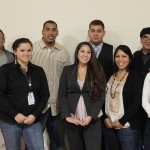
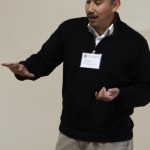
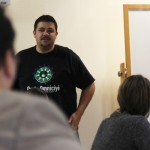
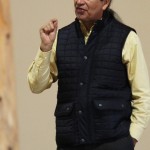
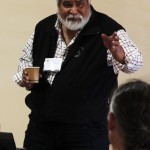
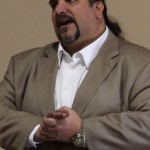
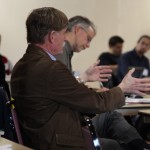
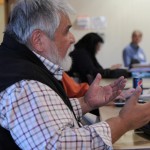
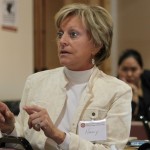
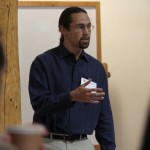
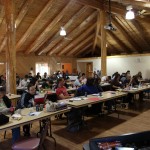
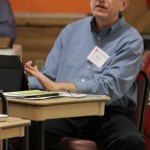
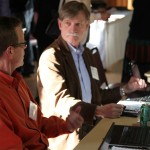
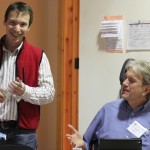
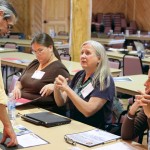
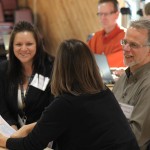
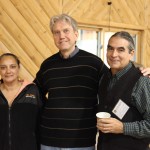
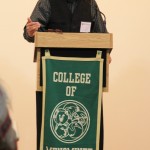
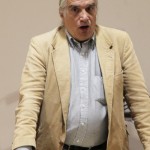
College of Menominee Nation successfully hosted the fall 2011 AIAN Climate Change working group this November 7 and 8, 2011. The working group began with an opening blessing as well as a song by K-Town Boys. Dr. Verna Fowler, CMN President, greeted guests and commended them on taking action against climate change. “I sincerely hope you have an enjoyable and profitable day,” Dr. Fowler stated. Melissa Cook, Sustainable Development Institute Director, also welcomed guests by adding; “I look forward to the dialogue we have and will continue to have on this important topic,” said Melissa. The working group then moved into action with key speakers and dialogue sessions.
Merv Tano, President of the International Institute for Indigenous Resource Management, talked about the importance of getting different sources of information and reading all sorts of educational journals. “You might’ve thought you knew something, but as it turns out, you were only partially right,” explained Tano. He stressed the importance of setting a research agenda for ourselves, and also for the people in the Arctic who are noticing signs of climate change at a rapid rate.
Dr. Bull Bennett, Kiksapa Consulting, added that the working group was headed in the right direction. “Instead of trying to do everything at once, we’re identifying key points and attacking it that way.” Dr. Bennett encouraged members of the working group to continue working on climate change issues. “Menominee really has taken the lead in a lot of sustainability issues,” said Bennett. Melissa Cook noted that Sustainable Development Institute is working more regionally and locally in identifying key questions and engaging community members.
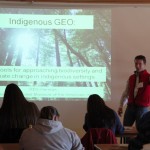
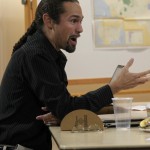
Doug Herman, Senior Geography, NMAI, gave a presentation and posed the question “What are we doing here anyway?” Herman guided working group members through a website project called BluePlanet. This developing site holds indigenous knowledge and personal accounts from American Indian people. Herman noted that educators sometimes question what is accepted as science and encouraged scientists to value American Indian dialogue and narrative. “Indigenous knowledge is science,” he stressed, “Stories always bring out important cultural values.” Physical Scientist Eric Wood, Early Warning & Environmental Monitoring U.S. Geological Survey, added: “We need to make sure, to the best of our ability, Indigenous communities have a voice somewhere.” He also added that we need to keep “hammering” about climate change.
Keynote speaker Bob Gough, Intertribal COUP, gave an engaging and inspiring talk on climate change. Gough, who researches mitigation and adaptation, is trying to get federal agencies to recognize what tribes have to offer. He emphasized that the work American Indians are doing is special and needs to be valued and recognized. “The Menominee are a great community as an example of taking care of that [the earth,]” said Gough. He also stressed that indigenous knowledge is not a thing of the past, but is valuable in solving problems today. “The tribes have really exercised stewardship over resources,” he said, “There’s an opportunity in climate change to use cultural values.”
Gough encouraged working group members to think outside the box. “We’ve got to keep moving, understanding, broadening, and learning,” stressed Gough. Participants engaged in dialogue concerning the rights of mother earth and where the future may be headed. “The future is a bit fuzzy,” noted Gough, “When there is a great deal of risk, proceed with caution. You’ve got to think your problems all the way through.” Discussion continued on the importance of protecting the earth for the future and how sustainability can be kept in mind. “It’s in the indigenous toolkit,” commented Gough.
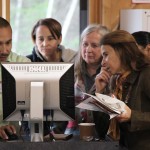
Students provided intriguing presentations during the working group and shared videos about their climate change research. Guests saw a presentation that highlighted severe climate change impacts on reindeer pasture and herding. More student presentations followed as well as a NASA Tribal Colleges and Universities Project Update from Nancy Maynard Ph.D, NASA Goddard Space Flight Center, Senior Research Scientist.
The working group wrapped up activities Tuesday afternoon by discussing where the next meeting would be. Members encouraged one another to keep researching, studying and spreading the word about the negative effects of climate change. “When you see activities that emerge out of these meetings, it just makes the circle bigger,” said Dan Wildcat. “We suffer sometimes from tunnel vision, it’s important to have those relationships with neighboring communities.”