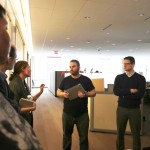
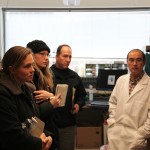
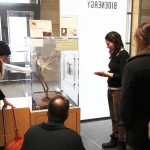
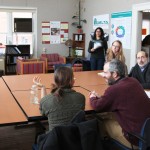
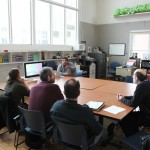
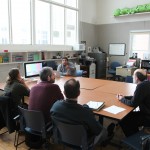
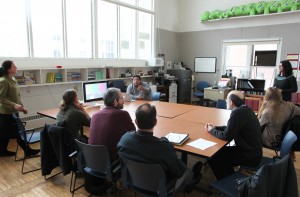
 On January 25, 2012, an SDI crew made up of Kate Flick, Dean Fellman, Patrick Waukau and Julie Edler visited Madison, WI. SDI worked on POSOH project developments and visited various research departments on UW-Madison’s campus. (The POSOH project is a USDA-funded project in which partnerships between UW-Madison researchers, the College of Menominee Nation, and educators in northern WI have formed to take on the challenge of finding sustainable energy solutions by preparing the next generation of citizens and scientists. Lessons are being developed to help teach children about the place they live and why it is unique.)
SDI was warmly greeted by POSOH hosts Hedi Baxter Lauffer, Rick Amasino, and Manali Sheth. Click here to read more about the POSOH project, the partnerships, and the folks involved.
It was the first time that anyone from the POSOH project was hosted at the Science House. Dialogue ensued about work taking place in the Fast Plants project as well as POSOH curriculum development. The POSOH project dialogue centralized around the principal of developing long-term community citizenry and careers for the future. “The work of POSOH is a service-driven project grounded in Menominee,” said Hedi, “If people come together and learn the whole process, they grow in the process and become involved in sustainability.” Place-based learning was highlighted as a key component to the POSOH project. “The goal is that students learn about sustainability and specifically learn in the place where they are from.” said Menali. Hedi added the following: “We’re developing cutting edge curriculum that’s both indigenous ecological knowledge and science-based. The culture piece isn’t just an add-on; it’s a part of it.”
 The group then visited UW-Madison’s beautiful new building, the Institute for Discovery. Ben Shapiro, postdoctoral research associate, shared work on “Trails Forward,” a game designed to teach sustainability concepts. Trails Forward aims to serve as a better way to develop connections in research and teach others about sustainability. Developed to teach the public, gamers would play different roles, such as the DNR, a housing developer, or a timber company through live interaction and place-based data capture. The game would prove to be an interesting lens by which to help understand how different people define “winning” in terms of sustainability. Ben noted that it was not about building a prototype, but about building a concept.
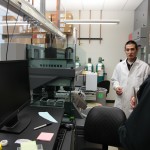
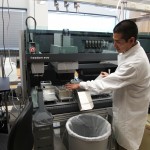
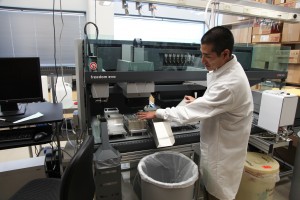 After lunch, the group visited Science House to meet with GLBRC researchers, Trey Sato and Yaoping Zhang. They work on fermentation research that breaks down bio energy and are funded by the US Department of Energy. Trey Sato demonstrated research in which he scales up the process of fermentation to create “modified, more improved versions.” Yaoping works further with Sato’s work where he monitors ethanol production and fermentation. “Our goal is to bring basic science to industry,” said Sato, “We’re tasked with doing the ‘risky’ science. It’s a hard slow process. It’s been challenging.”
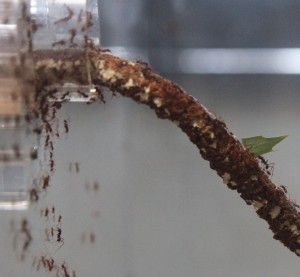 At another stop, researcher Gina Lewin gave SDI an introduction to the Currie Lab’s work with fungus-farming ants. Lewin fed the ants some leaves and explained the interesting work taking place at Currie’s Lab. Did you know that leaf-cutting ants don’t actually eat the leaves? They use the pieces to make fungus! Click here for more information.
Finally, the group reconvened at Science House for a preview of a POSOH video with videographer Reynaldo Morales and dialogue continued on future POSOH direction. The SDI staff wishes to thank the hosts and researchers for their generosity in sharing their information and work in collaboration efforts.